BK76 guide · Kitchen ergonomics
Kitchen drawers — ergonomics, Blum systems and precision manufacture
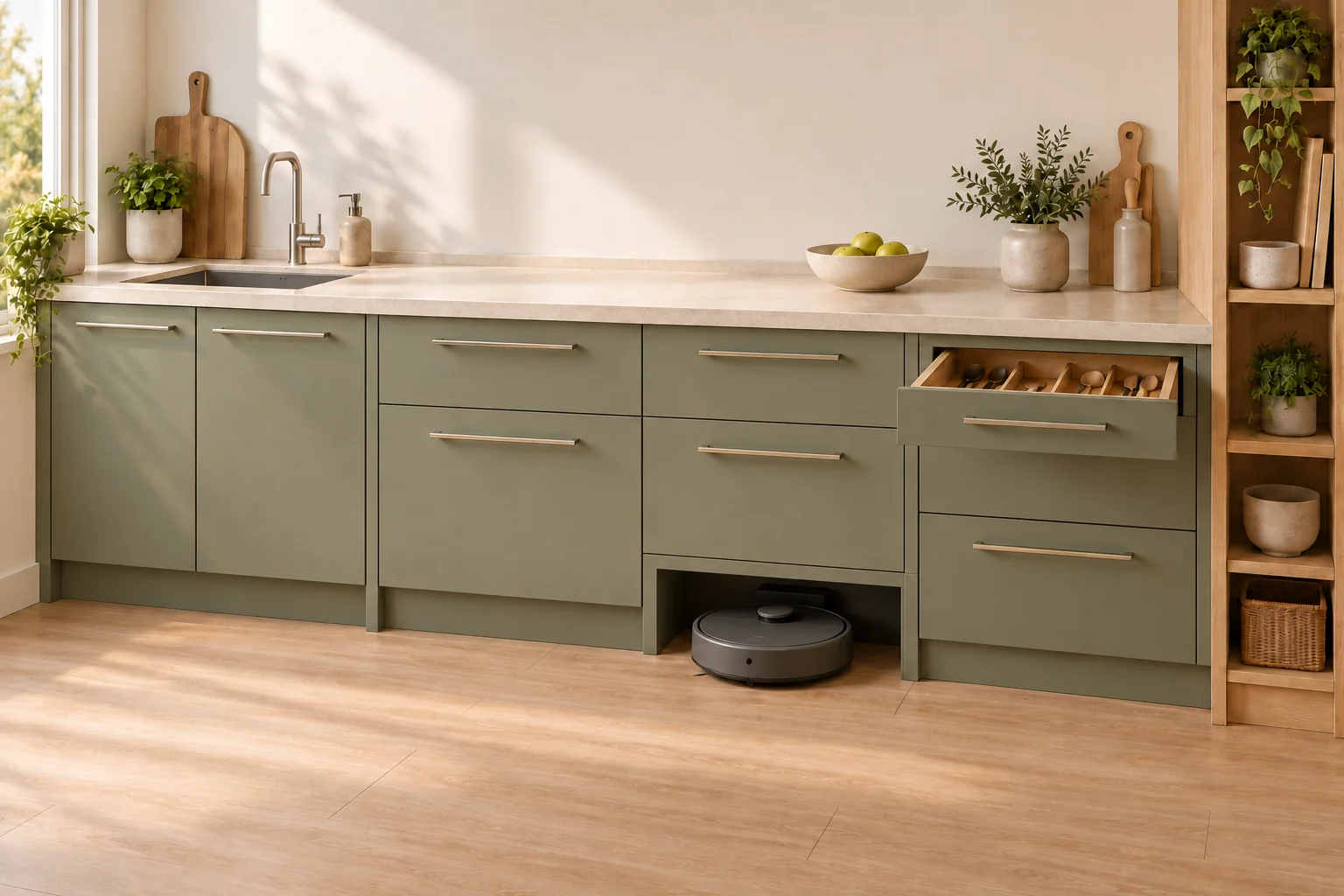
A beautiful kitchen should also be comfortable. Functionality depends not just on the cabinet layout but on access to stored items. The difference between a drawer and a shelf behind a door becomes clearest when retrieving a heavy pan from the back of a base cabinet.
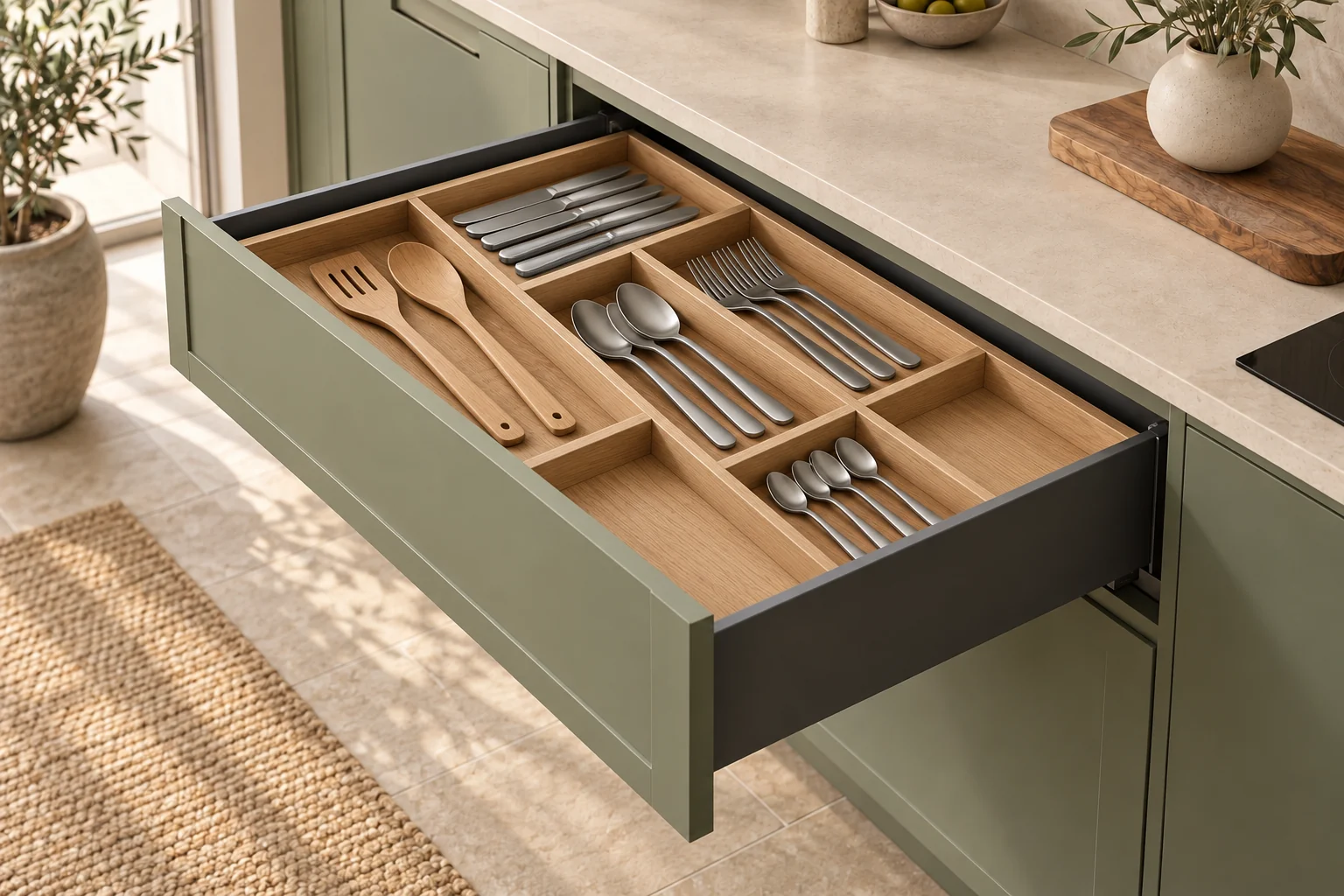
We open the door, bend down, move objects and search for the right one. In a full-extension drawer, the contents come out beyond the carcase, making them easier to see and retrieve.
A drawer instead of doors and a shelf — why consider it?
In kitchen base cabinets, drawers often provide easier access than fixed shelves, particularly for pots, pans, plates, containers and provisions.
The main benefits are:
- a better view of the contents;
- easier access to items at the back;
- less rearranging when looking for things;
- the ability to organise the interior with dividers;
- easier return of objects to their place.
This does not mean every cupboard should have drawers. Shelves remain sensible for many applications. Drawers need room to extend, and their mechanisms and sides occupy some internal space.
For base units, however, start the design by asking: would a drawer be more convenient here than a shelf behind a door?
Full extension — access to the rear of the drawer too
Not every runner extends a drawer to the same extent.
With partial extension, some contents remain beneath the worktop or inside the carcase. Full extension makes the rear of the drawer easier to use too. This is particularly important in deep kitchen cabinets.
TANDEM offers full- and partial-extension runners. When comparing quotations, ask about the specific version, not just the manufacturer name. TANDEM runner range.
Blum systems — a runner is not a whole drawer
It is worth distinguishing two groups of solutions.
TANDEM and MOVENTO are concealed runner systems for drawers made from wood or suitably selected board. The maker prepares the drawer box, while the runners provide its movement.
TANDEMBOX, MERIVOBOX and LEGRABOX are drawer systems with metal sides. Runners, fixings and other parts are selected for the chosen system, with a suitable base, back and front prepared as well. Overview of Blum systems.
These are not interchangeable names for the same product. They differ in construction, appearance, accessory options and manufacturing requirements.
Drawer load — how much can you really store?
A cutlery drawer works differently from a wide drawer full of plates or cast-iron pans. Select the load rating for the intended contents, dimensions and construction.
Example load classes in Blum ranges:
| System | Load classes* |
|---|---|
| TANDEM | up to 30 kg |
| MOVENTO | 40 or 70 kg |
| TANDEMBOX | 30 or 65 kg |
| MERIVOBOX | 40 or 70 kg |
| LEGRABOX | 40 or 70 kg |
* Availability depends on the specific variant and runner length. Data according to manufacturer ranges: TANDEM, MOVENTO, TANDEMBOX, MERIVOBOX, LEGRABOX.
The load class should not automatically be treated as the permitted weight of stored products alone. The moving drawer's own weight must also be considered in accordance with the selected system's documentation.
Base rigidity, front attachment and correct runner installation matter too. Higher-capacity hardware cannot repair poor construction.
Finishes — the kitchen interior can be carefully detailed too
The colour and shape of drawer sides affect the furniture's appearance when open. You can choose a calm, light interior or combine dark sides with a wood-effect drawer base.
For example, MERIVOBOX comes in silk white matt, indium grey matt and anthracite matt. LEGRABOX offers various matt finishes and fingerprint-resistant stainless-steel options. Availability must be confirmed for the chosen configuration. MERIVOBOX finishes, LEGRABOX pure and free.
Tall drawers can use rails, fuller sides or suitable decorative elements. Function should also guide the choice: tall packages and small objects need different protection from cutlery.
Opening and closing — four different solutions
| Solution | Opening | Closing |
|---|---|---|
| Handle or routed finger pull + BLUMOTION | Manual pulling | Damping and soft closing |
| TIP-ON | Mechanical assistance after pressing the front | Pressing the front; this should not be confused with soft closing |
| TIP-ON BLUMOTION | Mechanical assistance after a touch | A suitable push activates soft closing |
| SERVO-DRIVE + BLUMOTION | Electrical assistance after a touch | The drawer is closed manually, with the final movement damped |
TIP-ON BLUMOTION works mechanically, without electrical power. SERVO-DRIVE requires planning for a power supply and space for system components. Electrical drawer opening does not automatically mean electrical closing. Accessory compatibility must be checked for the specific system. TIP-ON, TIP-ON BLUMOTION, SERVO-DRIVE.
Handleless does not always mean more convenient
Smooth fronts can look impressive, but test the opening method on a sample.
A well-chosen handle can be more comfortable for someone with a weaker grip. A routed finger pull must provide enough room for fingers. Push-to-open systems need correct gaps, suitable mechanisms and adjustment.
Ergonomics should suit the user, not just the kitchen visualisation.
Interior organisation — function matters more than drawer count
A large undivided drawer can quickly become a place to put everything at random. Inserts, dividers and restraints help make the most of it.
It is worth planning:
- shallow drawers for cutlery and utensils;
- spice storage near the preparation area;
- pan drawers near the cooking area;
- stable plate storage;
- tall drawers for provisions;
- a suitable place for waste sorting.
Frequently used things should be within comfortable reach. Even the best runner will not improve ergonomics if essential items are stored in the wrong place.
Internal drawers concealed behind shared doors help maintain a calm exterior. Remember, though, that access then requires two actions: opening the door and pulling out the drawer.
Precision CNC manufacture — why does a drawer run smoothly?
Good hardware needs well-made furniture. Correct carcase dimensions and geometry, parallel runners and accurate fixing positions are important.
CNC machining helps achieve repeatability in:
- component dimensions;
- hole positions;
- routed recesses and cut-outs;
- runner and front fixing positions.
Manufacturing data must be prepared for the specific system. Blum documentation and configurators provide cutting lists, drilling positions and data for further design and manufacture, among other information. Blum cabinet configurator.
CNC alone does not guarantee quality. It helps execute a good design accurately — but can reproduce an error just as accurately.
Dimensional checks, correct carcase assembly, installation and final adjustment are therefore essential too. Good drawers can also be made using suitable jigs; CNC supports precision but is not its only source.
Complexity — more features mean more decisions
A simple drawer with a handle and soft close needs fewer components than a tall drawer with decorative sides, internal organisation and assisted opening.
Additional fittings may require synchronisation, an opening unit, stabilisation or a power supply. Not every accessory is needed in every drawer.
For push-to-open systems, matching the mechanism to the drawer specifications is particularly important. Simply fitting a “stronger” unit does not necessarily improve the result. Selecting TIP-ON BLUMOTION for MERIVOBOX.
More features do not automatically make a better kitchen. The best solution is one the user actually uses.
Prices — hardware is only part of a finished drawer's cost
Saying “a drawer costs PLN 200” means little until we know what the price includes.
To illustrate the differences, in retail offers checked on 7 October 2026:
- a pair of TANDEM TIP-ON runners, 500 mm, 30 kg, cost approximately PLN 106 including VAT, without the required additional locking devices and synchronisation — example runners;
- a MERIVOBOX hardware set, 500 mm, height M, 40 kg, cost approximately PLN 158 including VAT — example set;
- a LEGRABOX hardware set, 500 mm, height C, 40 kg, cost approximately PLN 246 including VAT — example set.
These are examples of different configurations, not a comparison of identical drawers or a BK76 price list. Prices may change. A hardware set does not mean a finished drawer with a front, all structural components and installation.
A complete quotation also includes:
- manufacturing the base, back or complete box;
- the front and its finish;
- additional mechanisms;
- interior organisation;
- machining, installation and adjustment.
A cupboard with a shelf and doors often costs less than an extensive drawer set. Balance the saving against the convenience of everyday use over the years.
Kitchen drawers at BK76 — designed around your needs
At BK76, we choose solutions to suit how you use your kitchen. We establish what will be stored, how often it will be used and which opening method is comfortable for the household.
In-house CNC machining helps us prepare components with consistent dimensions and fixing positions. We combine it with quality control, installation and adjustment.
The aim is not to put the most expensive system in every cabinet. It is to choose suitable construction, load capacity and fittings where they provide a real benefit.
A good drawer does more than open smoothly. It reduces searching and rearranging, making the kitchen more convenient to use.
Planning a bespoke kitchen? Let’s talk about your project — including what belongs inside the furniture.