BK76 guide · Materials
Joinery materials — what are furniture, cabinet doors and worktops made from?
Wood, plywood, veneer, furniture boards and modern composites have different properties. Explore the main joinery materials, types of cabinet doors and worktops, and how they affect the manufacture and price of furniture.
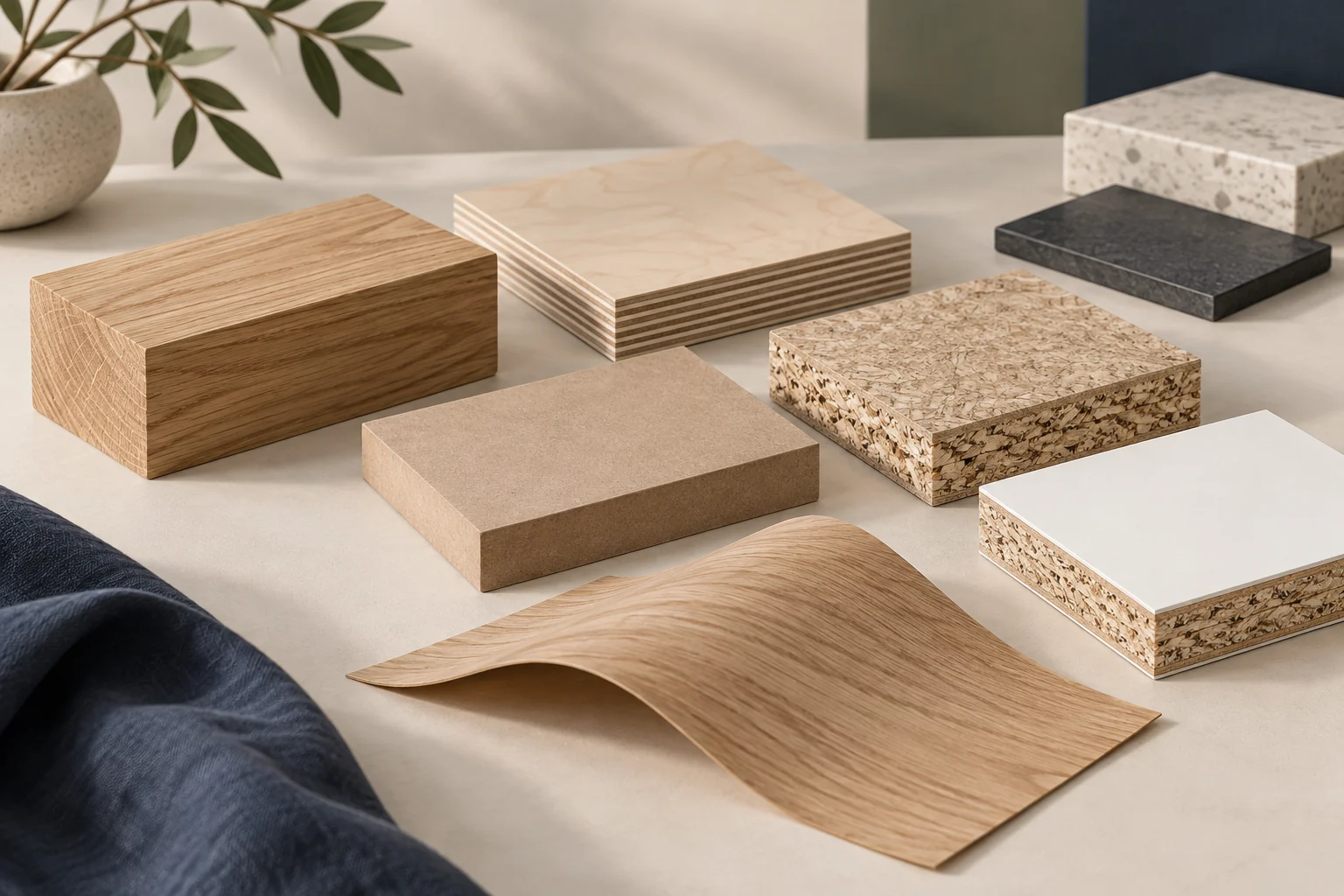
Choosing a material means more than choosing a colour. It determines the furniture construction, routing possibilities, finishing method, care and installation requirements. Two similarly sized pieces can look almost identical, yet be made from entirely different materials and require different amounts of work.
First, distinguish the structural material from the finish
Furniture often consists of several layers. The substrate may be chipboard, MDF or plywood, while the surface may be natural veneer, lacquer, laminate or acrylic. The properties of the finished component result from the combination of these layers and how it is made.
The term “natural oak” therefore needs clarification. It may mean solid oak, natural oak veneer or a wood-effect decor. These are different materials, although all can offer a similar colour effect.
Solid wood — tradition and unique grain
Wood has individual grain, shade and character. Oak, ash, beech, pine and walnut differ not only in appearance but also in hardness, machinability and behaviour in use. We use solid wood for tables, legs, frames, shelves and selected cabinet doors, among other applications.
This material responds to ambient humidity. Dimensional changes must be allowed for in construction and joints. Proper timber preparation, moisture content and the conditions in which the finished furniture is used are important.
One advantage of wood is the possibility of refreshing and repairing it, depending on construction and finish. This does not mean resistance to everything: water, high temperatures and dirt still need careful attention.
Plywood — layers of wood working together
Plywood is made from thin layers of wood, usually laid so that adjacent grain directions are perpendicular. This construction helps provide stability and good structural properties. Final specifications depend on the wood species, number of layers, thickness and type of bonding.
Plywood is used for carcasses, drawers, structures, curved components and furniture where the layered edge is intended as a visible detail. It can be lacquered, veneered or given another finish.
An important distinction: waterproof bonding does not make the wood itself completely waterproof. The application and protection of surfaces and edges must suit the furniture's working conditions.
Veneer — real wood on a suitable substrate
Veneer is a thin layer of natural wood. It retains the grain and character of wood, but is not the same as solid wood throughout the component. Veneering provides a wooden surface on a stable substrate.
What do we apply veneer to?
Typical substrates include MDF, chipboard, plywood and blockboard. The choice depends on component size, construction, shape, mounting method and conditions of use. Not every substrate is equally suitable for every project.
Veneering requires leaf selection and arrangement, substrate preparation, the correct adhesive, pressing and finishing. Layers must also be balanced on both sides of the component to reduce the risk of distortion.
The surface can be protected with lacquer or oil, among other finishes, depending on its application. Grain and shade may vary between components — a natural characteristic of wood. As veneer is thin, sanding and restoration possibilities are limited.
Thick veneer — a thicker layer of wood
Thick veneer is a thicker layer of wood than conventional thin veneer. It is bonded to a suitable substrate, giving a wooden surface with a greater material allowance. The exact thickness and application must be agreed for the specific product.
Greater thickness can offer more scope for machining and refreshing, but does not allow unlimited routing. Durability still depends on the substrate, bonding, construction and surface protection.
Joinery and furniture boards — what lies beneath the surface?
Unfinished chipboard
Made from wood chips combined with a binder and compressed. The unfinished version has no decorative coating. It can serve as a substrate for veneer or laminate, or as a material for structural components. A surface intended to remain visible generally needs a suitable finish.
Unfinished board is not laminated board. These are two different stages of material preparation.
MDF and HDF
MDF is a wood-fibre board with a relatively uniform structure. It is well suited to routing, profiling and preparing surfaces for lacquer. MDF is used for cabinet doors, decorative panels and fitted furniture components, among other things.
HDF is a higher-density fibreboard, often used for thin components such as furniture backs and drawer bases. Its properties always depend on the particular board grade.
Versions with increased moisture resistance are available. However, this should not be confused with full waterproofing. Edges, holes and finishes require protection appropriate to their application.
Melamine-faced board, commonly called laminated board
Common furniture board usually has a chipboard core and a factory-applied surface of decorative paper impregnated with melamine resin. It is available in plain colours, timber and stone decors, and other textures.
A practical material for carcases, shelves and many simple doors. The factory-finished surface reduces further operations, but edging and joints are still needed after cutting. Edge quality greatly affects appearance and durability.
The everyday term “laminated” is sometimes used broadly. When ordering, establish whether it means melamine-faced board or board covered with a separate HPL laminate.
HPL laminate — a separate surface finish
HPL is a laminate made from layers of resin-impregnated paper pressed at high pressure and temperature. The thin sheet is bonded to a suitable substrate, such as chipboard, MDF or plywood.
It is used for worktops, cabinet doors, panels and heavily used surfaces. Properties depend on the laminate grade and type, texture and the complete component construction. Bonding, a balancing layer and edge finishing must be considered.
Melamine-faced board and HPL-covered board are not the same solution. A similar decor does not mean identical construction or resistance.
Types of kitchen worktops — more than appearance
38 mm laminated worktops
A typical 38 mm worktop generally has a chipboard core and a laminated surface. The figure 38 mm indicates thickness, not a separate material type. Depending on the solution, the worktop may have a profiled front edge or a straight edge.
A wide range of decors, a practical surface and availability are key advantages. Joints, sink and hob cut-outs, and areas exposed to water need particular attention. An unprotected core can swell.
Compact HPL worktops
Compact HPL has a dense, multi-layer construction without a chipboard core. It allows slim worktops to be made, and its properties suit applications requiring moisture resistance.
Machining and installation guidelines must still be followed. Support, fixing, openings and expansion gaps matter. Compact HPL is not the same as an ultra-compact mineral material.
Timber worktops
They provide a warm, natural effect and can be refreshed, depending on their construction and finish. They need maintenance and allowance for wood movement. Protection around the sink and avoiding prolonged contact with standing water are particularly important.
Granite, marble and natural quartzite
Granite is a natural stone with an individual pattern. Its properties and need for sealing depend on the specific variety and finish. Weight, transport and precise installation are important aspects of the project.
Marble is valued for its appearance but can be more demanding in a kitchen: it may react to acids and be susceptible to scratches. Sealing does not eliminate the risk of chemical etching. Natural quartzite is a different material from engineered quartz — these names should not be used interchangeably.
Engineered stone and mineral composites
These combine mineral components with a binder, depending on the material's manufacturing process. They make certain colours and patterns easier to achieve. Resistance to heat, stains and outdoor conditions must be checked for the specific variety — not assumed for the whole group based on its name.
Sintered stone and large-format ceramic slabs
These allow thin surfaces and large formats with varied aesthetics. The commercial term “quartz sinter” is often used, but it does not mean engineered quartz.
For worktops, thickness, support, edge and cut-out fabrication, and safe transport are crucial. A durable surface does not mean every corner is immune to impact. Material selection must also take account of the manufacturing method.
Mineral-acrylic solid surface materials
This group allows complex worktop shapes, integrated sinks and joints with barely visible seams. The material can be machined and, under appropriate conditions, repaired or refinished.
Its advantage is freedom of form, not resistance to every kind of stress. Use trivets under hot dishes and a chopping board. Suitability for thermoforming and repairs depends on the specific material, colour and construction.
Stainless steel, glass, concrete and other solutions
These materials can give an interior a distinctive character, but require an individual design. Weight, signs of wear, care, joints and repairs all need consideration. Visual effect should not be the only selection criterion.
Types of cabinet doors
The door is the most visible part of a cabinet, but its choice should also reflect function. A heavily used kitchen needs different solutions from a chest of drawers or a bedroom wardrobe.
Furniture-board cabinet doors
These are usually plain cabinet doors cut from melamine-faced board with finished edges. They offer a wide range of decors and require less work than multi-stage lacquering. Cutting accuracy, edging quality and corner execution all matter.
Lacquered cabinet doors
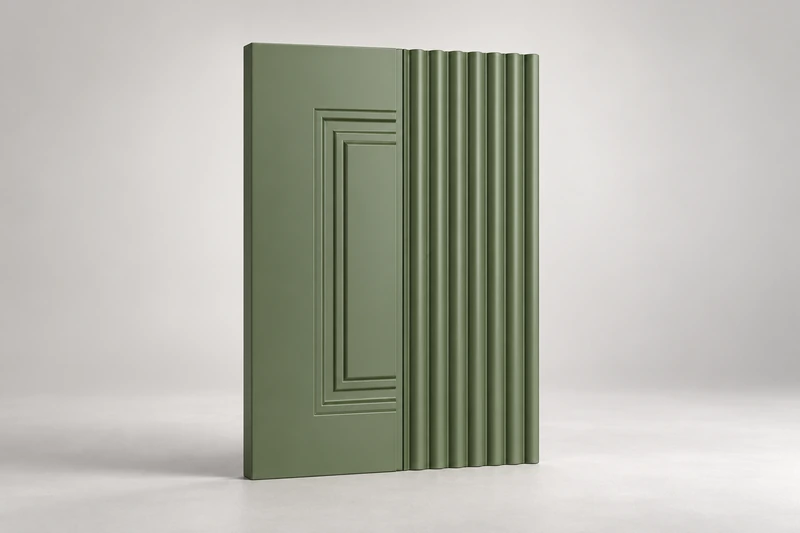
These are usually made on MDF. They allow a choice of colour and gloss level, as well as routed details, fluting and profiles. Quality depends not only on the lacquer, but also on substrate preparation, priming, sanding and subsequent finishing stages.
An individually lacquered cabinet door is not the same as a component cut from a factory-lacquered board. When choosing, establish the process, edge finish and feasibility of the particular design. See our lacquered cabinet door catalogue.
Acrylic cabinet doors
These have an acrylic surface bonded to a substrate, often MDF. They come in various versions, including matt and gloss. Scratch resistance, the visibility of fingerprints and cleaning instructions depend on the specific version.
Edge finishing matters too. The name “acrylic” alone does not tell you everything about a finished door's quality or suitability for routing.
Veneered and wooden cabinet doors
Veneer shows the natural grain of wood on a selected substrate. Solid wood can form the entire door or its frame. In either case, grain, construction and finish need planning, rather than treating wood as a uniform-colour coating.
HPL, foil-wrapped, PET and framed cabinet doors
HPL-covered doors require a suitable substrate, bonding and balancing layers. Foil-wrapped doors and PET-faced doors have different forming possibilities and limitations in use, depending on the complete system. They should not be assumed to have identical properties.
Framed doors can incorporate glass, rattan, woven material or decorative lattice infills, including veneered components. Their character comes not just from the material, but also from frame proportions and how the infill is secured.
Why does material affect furniture price and labour?
A sheet of board, a veneer leaf or a stone slab is just the beginning. The material dictates tools, machining methods, the number of operations and transport requirements. It also affects waste and the risk of damage during the project.
- Selection and layout: timber selection, grain matching and pattern continuity between cabinet doors.
- Machining: cutting, gluing, pressing, routing, sanding and preparing joints.
- Finishing: edging, priming, lacquering, oiling and protecting vulnerable areas.
- Construction: substrate, balancing layers, support and suitable fixings.
- Transport and installation: weight, overall size, fragility, access to the room and required equipment.
A plain melamine-faced board door and a routed lacquered door of the same dimensions require different numbers of operations. Similarly, buying thin veneer does not mean the finished component will be cheap: leaf selection, substrate preparation, bonding, pressing and finishing are additional steps.
Material utilisation matters too. Grain continuity, sheet sizes and component layouts can increase the amount of raw material needed. Comparing price per square metre alone is therefore not enough.
The price of finished furniture includes material and its utilisation, machining, finishing, hardware, design preparation, and agreed transport and installation. Material has a significant effect on the quotation, but it is not the only factor. We explain more in our guide on the price of bespoke furniture.
How do we select materials at BK76?
We start with the furniture's function, conditions of use and budget. We then combine appearance with manufacturing technology. No single material is best for every application — appropriate selection and careful workmanship are what count.
Samples help you see texture, colour, wood grain and edge finishes. Compare them with the worktop, flooring and interior lighting before making a final decision.
At BK76, we make bespoke furniture in Wrocław, selecting materials for each individual project. The starting point may be an architect’s design, a client’s sketch or supplied inspiration. We can also create an individually designed cabinet door.
These material descriptions are a starting point for discussion, not a substitute for documentation for a specific product. Before manufacture, we confirm the specifications, construction and care requirements of the chosen solution.