BK76 guide · Choosing a contractor
How to choose a trustworthy bespoke kitchen contractor
Check more than the price: experience, production premises, material samples, exact fittings and terms of cooperation.
A bespoke kitchen is an investment for years to come. When choosing a contractor, it is easy to focus on door appearance, worktop colour and the final price. Equally important, however, is whom we entrust with the design, money and delivery.
What should you check before signing a contract and making an advance payment? There is no single foolproof test. There are, however, several concrete checks that help you make a more informed decision.
The conversation that inspired this article
A client called our company looking for another kitchen contractor. According to his account, he had ended the first working relationship because of poor furniture quality. The second contractor took an advance payment but did not fulfil the order.
During the conversation, we explained that we run a company, sign contracts and issue invoices. The client declined, saying he would look for a contractor who would work without an invoice.
We are not sharing this story to judge anyone. We understand that budgets matter. It does, however, highlight an important issue: after a bad experience, it is worth changing not just the contractor but also how you assess them.
1. Establish whom you are actually contracting with
Ask for the full company name, NIP tax number and contact details. Check that these match the quotation, contract and billing documents.
Business details can be checked in the public CEIDG or KRS registers, accessible via Biznes.gov.pl. Registration alone does not guarantee a well-made kitchen, but it establishes who is party to the order.
A phone number and social media profile should not be the only information you have about someone you are paying.
2. Ask where and how the furniture is made
Does the contractor have a workshop? Where is production carried out? Can you arrange a visit to see samples or components being made?
In-house machinery can help with quality control, production planning and alterations. Ask about cutting, edging, CNC routing and preparation of unusual components.
This does not mean every good joiner must own every machine. Working with a trusted lacquering or machining specialist is normal practice. What matters most is that the contractor clearly explains what they do in-house, what they subcontract and who is responsible for the whole project.
3. Check experience with similar projects
Years of practice matter, but simply claiming “we have worked for many years” is not enough.
Ask for examples of kitchens similar to yours: with tall units, a compact worktop, an unusual corner or a concealed pantry entrance. Ask what challenges arose during the project and how they were resolved.
Experience also shows in the questions a contractor asks. They should be interested not only in door colours, but also services, appliance models, ventilation, door opening and how you use the kitchen.
4. Inspect the details, not just impressive photos
A website and portfolio help you get to know a company, but a beautiful photo does not show everything.
Look at close-ups of edges, worktop joints, gaps between doors and side finishes. If you can see completed furniture, check how drawers and doors operate too.
Photos may be brightened or tidied up before publication. They should not replace an honest view of the actual construction and workmanship. A design visualisation is also different from a photograph of a completed project.
Samples before manufacture — check quality before ordering
Photos and visualisations cannot replace seeing the material close up. Ask whether the contractor will prepare samples before production so you can assess not just colour but also machining quality.
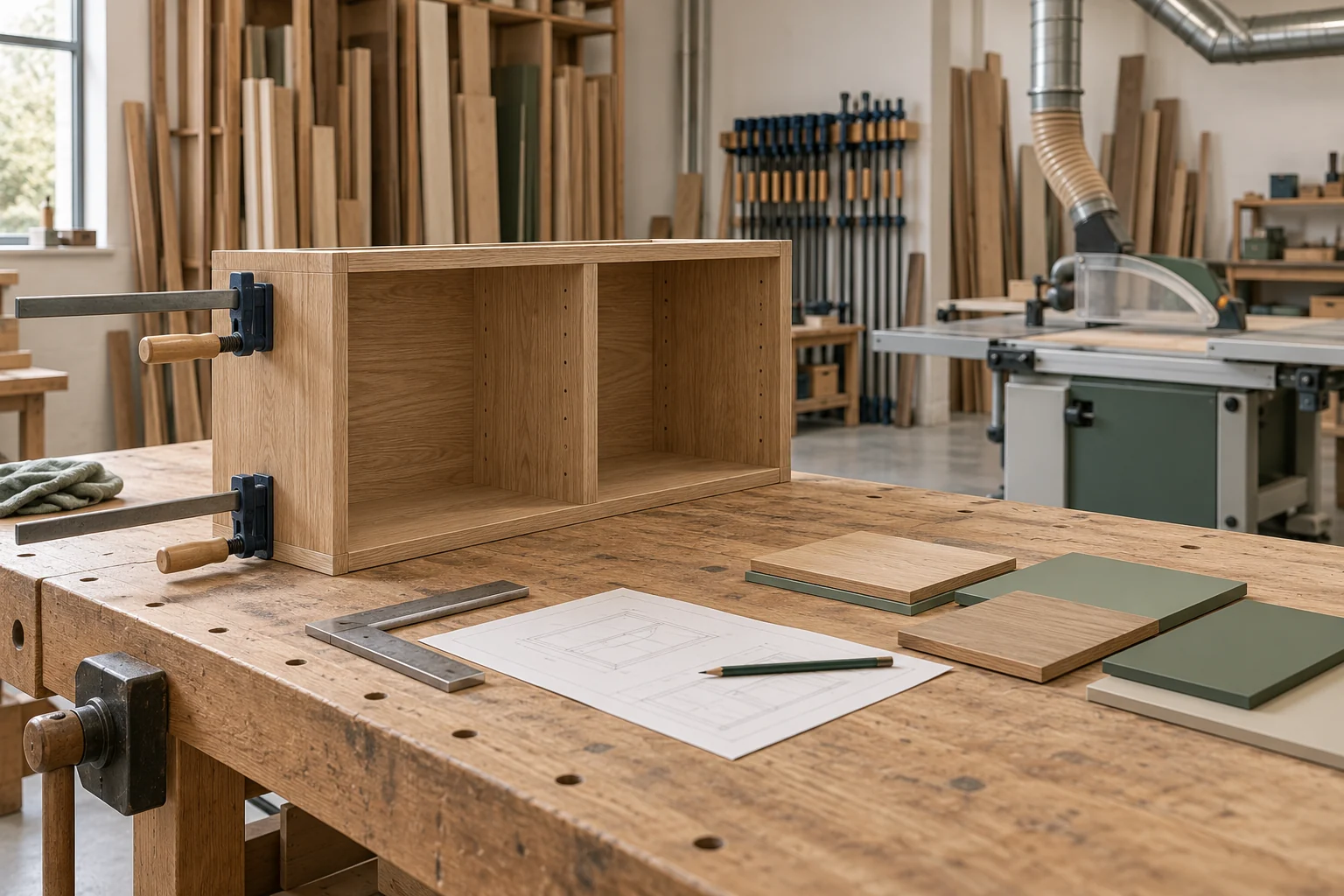
Before manufacture, BK76 prepares samples of board cutting and ABS edging, as well as cabinet doors and worktops. Clients can inspect the cut line, the accuracy of the edging joint, and the colour and texture of the chosen materials.
It is also an opportunity to compare a cabinet door with a worktop in your own interior's lighting. We want decisions to be based on real samples, not solely on a photo or decor name.
5. Read reviews and check reputation
Look beyond the star rating. Seek reviews describing a specific working relationship: surveys, communication, installation, punctuality and responses to concerns.
Ask for references from previous clients, shared with their consent. How the company responds to difficulties matters too. Even a well-prepared order may need adjustments — what counts is how they are handled.
Reputation comes from consistent work, not advertising alone.
6. Compare the scope, not just the final price
Two kitchens that look similar in photos can differ in materials, hardware and scope of work.
Check whether the quotation specifies manufacturers and material references, worktop type, hinges and drawer runners. Establish whether the price includes the survey, design, transport, installation and all agreed finishes.
Ask about the total amount payable and how changes are charged. Cheaper does not always mean worse, but a price difference should have an understandable explanation.
“We use Blum” — the brand alone does not tell the whole story
One manufacturer's accessories may differ in price, construction, finish standard and application. Saying “we use Blum hardware” is therefore not enough to compare two kitchen quotations reliably.
For hinges, the specific model, opening angle, mounting method, soft-close function and suitability for the door matter. A manufacturer's logo does not mean every quotation offers an identical solution.
The same applies to drawers. TANDEM is a concealed runner system for wooden drawers, whereas LEGRABOX is a drawer system with metal sides, also available in a stainless-steel version. These are different constructions and finishing possibilities, not two names for the same product. Manufacturer information: TANDEM and LEGRABOX.
When comparing quotations, ask about the hardware series and model, load capacity, full or partial extension, opening and closing method, and optional accessories. Also establish whether the price covers a single component, a pair of runners or a complete drawer.
A more expensive solution is not always necessary, and a simpler one need not be poor. It should suit the intended use and be clearly described in the quotation.
Compare specific solutions, not just the manufacturer's logo.
7. Contracts, payments and documents should be clear
A written contract helps organise the arrangements. It should identify the parties, scope of work, approved design, materials, price, payment schedule, dates and handover process. Agree procedures for reporting defects and approving changes too.
An advance payment for materials is not inherently a cause for concern. It should, however, follow specific arrangements and be documented. Also check whether the payment is a ‘zaliczka’ (advance payment) or ‘zadatek’ (earnest money) — these have different legal consequences under Polish law, as explained by UOKiK.
An invoice does not guarantee quality. Its absence does not automatically remove the right to complain either — a purchase document is not the only possible evidence of a transaction, as noted by UOKiK. However, it is unwise to deliberately forgo documents that help demonstrate what was ordered and paid for.
8. Pay attention to communication
A trustworthy contractor need not promise that everything is possible. They should be able to explain limitations, suggest solutions and confirm important arrangements.
Warning signs include pressure to pay immediately, reluctance to provide company details, an unclear quotation scope, resistance to documenting payments and promises without a specific schedule.
A good working relationship begins before production — with clear communication and mutual understanding.
Save on solutions, not on transparency
If the budget is limited, discuss simpler construction, a different material or fewer costly extras. These are practical ways to reduce the price without giving up a properly organised working relationship.
At BK76, we sign contracts and issue invoices. We want clients to know what they are ordering, what they are paying for and how the project will proceed.
A good kitchen starts with good design. A secure working relationship starts with clear terms.